Keycloak vs Auth0 Comparison: Which Fits Your Team
Teams often pick an identity provider in an afternoon, then live with the choice for years. In a Keycloak vs Auth0 comparison, Auth0 wins on speed and zero operations, while Keycloak wins on cost at scale, data residency and deep customization. The deciding variable is whether you have platform capacity to run a stateful, security-critical service, and the common mistake is choosing on the first month's effort instead of year-three cost and exit.
Key takeaways- Choose Auth0 when you have a small team, no platform engineer and a need to ship login this sprint. Choose Keycloak when you have regulated data, EU residency needs or a consumer-scale user base.- Auth0 bills by monthly active user and feature tier, so cost follows growth. Keycloak has no per-user licence, but you pay in infrastructure and engineer time.- Identity sits on the login path, so every outage reaches every feature. Name who patches the service on the day a CVE lands; if nobody, favor hosted.- Test exit before entry. Prototype your hardest login flow in both products and try exporting users and credentials.- If an Auth0 setup works and fits the budget, do not migrate for savings alone. Migration risk usually outweighs the savings.
The short answer: Auth0 for speed, Keycloak for control
Auth0 is hosted. You get a polished dashboard, quick SDKs and no servers to run. Time-to-first-login is measured in hours, not weeks.
Keycloak is open source and you run it. That buys you control over data, flows and cost curve. It also hands you every operational duty that Auth0 absorbs.
Neither choice is wrong. A Skycloak post on LinkedIn, written by a vendor that hosts Keycloak, frames it as zero ops, fastest time-to-first-login and a polished dashboard for Auth0, versus no per-MAU meter, LDAP and Active Directory federation, custom SPIs and no lock-in for Keycloak. That matches my own reading of the trade. It is also a vendor's summary, so treat it as a clue about the shape of the trade-off, not proof of it.
The mistake I would warn against is optimizing for the first month. Month one rewards whoever has the fastest quickstart. Year three rewards whoever has the better cost curve and the cleaner exit.
Who this guide is for
I will assume you are building a product with real users and a login path that matters. If you only need a prototype with a handful of testers, either tool is fine and you should pick the one you already know.
I write this from my background running platform, security and identity on a classifieds platform with 400K+ users. I run Keycloak there on Kubernetes, with zero-downtime releases as a hard requirement. That shapes my bias: I value control, and I know what it costs.
The criteria that matter and why
Feature checklists hide the real differences. Both products do OIDC, SAML, social login and MFA. The questions below separate them.
Operational load
Identity is on the login path. When it is down, nobody signs in, so every feature behind authentication is down too. That raises the stakes on upgrades, database health, clustering and CVE response.
With Auth0, the vendor carries that load. With Keycloak, your team does. A hosted outage is out of your hands, but a self-hosted outage is also your incident, your pager and your postmortem.
Pricing model
Auth0 scales per monthly active user and by feature tier. Keycloak costs infrastructure plus engineer time. Neither is free.
I will not quote current prices here, because they change and vary by plan. Check Auth0's pricing page and your own cloud bill before you decide.
Customization, residency, protocols and exit
Four more criteria deserve a row each:
- Customization depth. How far can you bend login flows, user models and themes before the product pushes back?
- Data residency and GDPR control. Where do user records live, and who can access them?
- Protocol coverage. Do you need SAML, OIDC, LDAP or Active Directory federation, and in which direction?
- Lock-in and exit cost. Can you leave, and what does leaving take?
Practical rule: Rank these criteria before you open any pricing page. A requirement you cannot trade away, such as residency, should eliminate options before cost does.
Auth0: strengths and weaknesses
Strengths
Auth0 is quick to adopt. The hosted dashboard is polished, SDKs cover common stacks, and Actions give you hooks into the login pipeline. Managed attack protection and breached-password detection are part of the pitch, though which tier includes them depends on your plan, so confirm in the current docs.
An Infisign review reports that developers can paste a few lines of code to get a working signup box instead of building security from scratch. Infisign sells an alternative identity product, so it has a motive to emphasize Auth0's later pain. The speed claim still matches what most teams report, and it is the real reason Auth0 wins early.
Weaknesses
The main weakness is cost growth. Per-MAU pricing climbs with consumer-scale user counts, and enterprise features such as SSO connections sit in higher tiers.
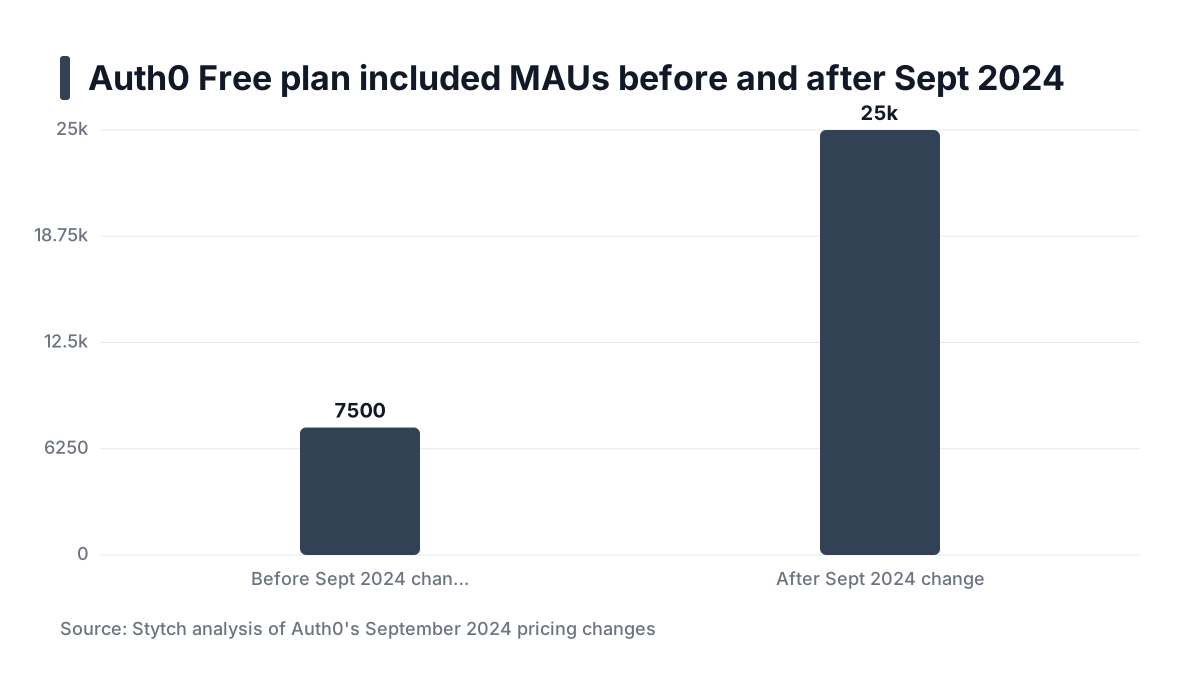
A Stytch analysis of Auth0's September 2024 pricing changes noted that the Free plan's included MAUs rose from 7,500 to 25,000. The same piece argues the Free plan cannot be used if you need a custom domain, MFA, roles and permissions, performant bot protection or support beyond the community forum. Stytch competes with Auth0, so read the framing with care. What the numbers do show: the headline free allowance and the plan you can actually ship on may be different things. Always price the tier that includes your required features.
Limits
Custom flows are bound by the Actions sandbox. If your login logic needs something the sandbox does not allow, you work around it or you hit a wall. Keycloak lets you write code that runs inside the server, which is a different level of freedom.
Exit planning matters early. The Infisign review says you cannot easily export user password hashes through standard self-service tools, and it calls this a major obstacle to moving later. Check Auth0's current documentation for the export process and ask support what it requires. Without hashes, a migration means forcing password resets for every user, and that is a real cost at scale.
Practical rule: Before committing to a hosted provider, ask how you would leave it. If the answer is "forced password reset for everyone," price that into year three.
Keycloak: strengths and weaknesses
Strengths
Keycloak is open source, with no per-user licence. It offers realms for separating tenants or environments, SPIs for extending server behavior, identity brokering for federating other providers, and fine-grained authorization. User data lives in your own database, which simplifies residency and GDPR conversations.
I manage identity as code with Keycloak and Terraform. Realm configuration becomes a pull request: reviewable, diffable and repeatable across environments. That is a genuine advantage over clicking through a dashboard, and it makes disaster recovery a deployment instead of a rebuild.
Weaknesses
You own upgrades, Infinispan clustering, database tuning, themes and CVE patching. This is the honest cost, and it is not small. Teams that underestimate it end up with an unpatched identity server, which is worse than any per-MAU bill.
Same-day CVE response across Kubernetes clusters is a discipline, not a feature. I scan every image with Trivy in CI and treat identity images as the first to patch. If you cannot staff that, do not self-host.
Running it on Kubernetes
Zero-downtime releases take deliberate design. A 2021 post on the official Keycloak forum describes a user on OpenShift who reported that changing the image version made the application unavailable while all pods were terminated before the update. That is one user's report on an older operator version, so it proves nothing about current behavior. It is a clue about where to test: rolling updates of a clustered, stateful service are not automatic.
A Keycloak maintainer's 2023 GitHub issue proposed moving guides for running Keycloak on Kubernetes in a high availability, active-passive setup into the main repository. This does not tell you what to deploy today. It does show that high availability has its own design guidance, and you should read the current official guides for your version.
An honest limitation: I cannot tell you exactly how many engineer-hours this takes for your team. It depends on your cluster maturity, your database operations and how strict your uptime target is.
Reporting rule: When you report Keycloak's cost, include engineer time and on-call load beside the infrastructure bill. Otherwise the comparison with Auth0 is rigged.
Side-by-side comparison table
Each cell is marked as a strength, neutral or a risk. I do not total the scores, because requirements are not equally weighted. The cost curve is where the two diverge, so the user-count column carries the most weight.
Row | Auth0 | Keycloak | At 10K vs 400K+ users | Watch out for |
|---|---|---|---|---|
Hosting | Strength: fully hosted | Risk: you host it | Hosting burden grows with traffic and uptime targets | Underestimating who is on call |
Ops effort | Strength: vendor handles it | Risk: upgrades, clustering, database, patching | At 10K a small team copes; at 400K+ it needs dedicated capacity | A "set and forget" assumption |
Pricing model | Neutral: per MAU and by tier | Strength: no per-user licence | Per-MAU cost rises with users; Keycloak infra cost grows more slowly | Comparing only month-one invoices |
Customization | Neutral: Actions within a sandbox | Strength: SPIs, flows, themes | Small gaps at 10K matter at 400K+ | Custom SPIs that block upgrades |
Data residency | Neutral: depends on plan and region options | Strength: your database, your region | Matters more as regulated users grow | Assuming "hosted in the EU" meets your legal bar |
Protocols | Strength: broad coverage | Strength: broad, including LDAP and AD federation | Equal at both sizes for most needs | Enterprise SSO connections priced in higher tiers on Auth0 |
Multi-tenancy | Neutral: tier-dependent | Neutral: realms work, but many realms add load | Many tenants strain Keycloak realms at scale | Realm sprawl in one cluster |
Support | Strength: vendor support on paid plans | Risk: community unless you buy it | Incidents at 400K+ users need a named owner | Relying on forum answers during an outage |
Exit cost | Risk: password export is not self-service | Strength: you hold the data | Exit complexity grows with the user count | No tested export before launch |
For protocols, I mark both as strengths because the Skycloak post lists LDAP and Active Directory federation as an out-of-the-box Keycloak strength. Auth0's equivalent depends on plan, so verify it in the current documentation.
Choose by situation, not by winner
Small team, B2B SaaS, no platform engineer
Choose Auth0. Your scarce resource is engineering attention, and spending it on an identity cluster is a poor trade. Accept the per-MAU curve and revisit the choice if your user count changes the math.
Watch your SSO connections. Stytch argues that SAML connections and non-Okta providers are priced separately and not disclosed on Auth0's site. That is a competitor's claim, so verify it with a quote. If B2B customers will demand SAML, price it up front.
Regulated, EU data residency or large consumer base
Choose Keycloak. Residency and GDPR control are simpler when user records live in your own database. A large consumer base also makes a per-MAU meter the dominant line item.
Do this only with real capacity behind it. Budget for upgrades, database tuning and patch response as recurring work, not a one-time setup.
The middle path: managed Keycloak
A managed Keycloak trades some control for less ops. I am building managed Keycloak on Kubernetes as a side project, called RealmDeploy, and it is listed as coming soon. Other vendors, Skycloak among them, already offer managed Keycloak, so compare what exists today.
Avoid this path if you need custom SPIs on your own schedule. A managed provider controls the upgrade cadence and what code can run in the server. Ask about both before signing.
When not to switch
If your Auth0 setup works and sits under budget, leave it. Migration touches every login, every token and every integrated app. The savings rarely justify the risk unless pricing or residency forces your hand.
Practical rule: Switch providers because a requirement changed or a cost curve broke your budget, never because a comparison post made the other side look cheaper.
Run this decision routine before you commit
- Estimate monthly active users at 12 and 36 months, and price both options at those numbers. For Auth0, use the tier that includes the features you need, not the free allowance. For Keycloak, add infrastructure plus the engineer hours you will realistically spend.
- List mandatory requirements. Include data residency, SAML or OIDC federation, custom flows and MFA methods. Any option that fails a mandatory item is out, whatever it costs.
- Name who patches the identity service the day a CVE lands. Write down a person and a backup. If nobody can own it, favor hosted.
- Prototype your hardest login flow in both, then test export of users and credentials. The hardest flow exposes sandbox and customization limits early. The export test shows what leaving would require, including whether password hashes come out at all.
- Write the exit plan, review it each year, and put the choice in an architecture decision record. Record the numbers you used, the requirements that decided it and the trigger that would reopen the question.
For more notes on running infrastructure like this, see more platform engineering notes.