Staff Engineering by Will Larson – Summary With Notes and Highlights

For years, the software industry had one answer for engineers who wanted to keep growing: become a manager. Staff Engineer by Will Larson is about the other path, the one where you keep writing code, keep making technical decisions, and still grow your influence, your scope, and your salary.
I picked this book up after a short stint as an Engineering Team Lead. I left that role because the company was poorly organised and the position was never made official. That experience pushed me to read both this book and The Manager's Path, to figure out which direction I actually wanted to grow in: the management track or the technical one.
Here are my notes, my highlights, and the ideas I keep coming back to.
🚀 The Book in 3 Sentences
- There is a real career path past senior engineer that doesn't require managing people, but it's a different job, not "senior with more experience."
- Staff engineers spend much less time coding and much more time on direction, alignment, and making other engineers effective.
- Getting the title takes a mix of doing the work, packaging it well, and having a sponsor. Skill alone is rarely enough.
🎨 Impressions
You don't read this cover to cover for pleasure. It reads more like a field guide. The first half explains what staff-plus roles look like day to day, and the second half is a set of interviews with staff and principal engineers at companies like Stripe, Slack, and Fastly.
What I appreciated most is that Larson doesn't romanticise the role. He's blunt about the fact that the title fixes fewer problems than people expect, and that a lot of the work is boring on paper: writing documents nobody asked for, sitting in meetings, saying no.
The book started out fun for me: I realised I'd already experienced all four staff archetypes at some point, and Architect and Solver are the ones I enjoy most. But the real value came later. The further I read, the clearer my thinking got, and in the end the book helped me decide not to pursue this role. Staff+ roles are genuinely inconsistent across companies, and the archetypes look different depending on org size and culture. In many companies "staff engineer" is just a senior engineer with more scope; in others it's a quasi-executive technical role. There's often no defined path to it either. Promotion usually depends on a "staff project" materialising, org needs, and sponsorship, which is partly luck. That's not a game I want my career to depend on. The last part of the book, the interviews, dragged a little. I could have skipped them, but they were interesting enough, and hearing those engineers describe their paths mostly confirmed the conclusion I'd already reached.
👤 Who Should Read It?
- Senior engineers wondering what comes next, especially if you looked at the management track and felt nothing.
- Engineers already doing staff-level work without the title. The chapters on promotion packets and sponsorship are written for you.
- New engineering managers who want to understand what to expect from their most senior ICs and how to grow them.
Who should skip it: engineers in their first few years. Most of the advice assumes you already operate at a solid senior level. If you're earlier in your career, a book like The Pragmatic Programmer or The Missing README will serve you better right now.
☘️ How the Book Changed Me
Reading this book changed how I work with my managers and colleagues, and it reshaped my mindset about technical leadership. The "Operating at Staff" part was the most useful for me. If you're short on time, read that part first; if the role still appeals to you, continue with "Getting the title where you are" and "Deciding to switch companies." Here's what stuck with me:
- To lead, you have to follow. Being a better leader sometimes means committing to your manager's direction even when it wasn't your idea, instead of quietly resisting it and I do this always.
- Learn to never be wrong. This isn't about always being right. It's about caring less about winning the argument and more about reaching a useful outcome, by listening and asking questions before pushing your own view.
- Create space for others. This chapter settled something I'd been chewing on for years. I once had a manager whose approach I admired at first. He pushed his own ideas in every discussion because he believed he was the most professional person in the company and that his knowledge was bulletproof. After four years of working with him, I saw him proven wrong several times, in situations where my ideas or other people's would have worked better, but he never gave anyone the room to try. This book confirmed what I had slowly figured out: that style isn't strength, it's a ceiling he put on the whole team.
- Build a network of peers. I've been doing this for years without a name for it: meeting new people at meetups, building tools and open source packages for other developers. Reading this chapter reinforced that this habit is one of the best long-term investments in a career.

✍️ My Top 3 Quotes
- Past senior, your value stops being the code you write and becomes the problems you choose.
- A promotion is not a reward for quiet hard work. It's the output of a system: the work, the story around it, and a sponsor willing to fight for it.
- The title gets you into the room. It doesn't make anyone listen once you're there.
📒 Summary + Notes
Staff engineer is a different job, not a bigger version of senior
The main idea of the book: senior is the last level where your job is mostly to build the thing well. Past that point, your impact stops being measured by your own output and starts being measured by the output of the organisation around you.
Larson is honest about the numbers here. Many staff engineers he interviewed write surprisingly little code. Their leverage comes from picking the right problems, unblocking teams, and setting direction. If your favourite part of the job is being heads-down in an editor all day, you want to know that before you chase the title.
The four archetypes
This is the framework the book is best known for. Larson found that "staff engineer" means four fairly different jobs depending on the company.
- Tech Lead guides the approach and execution of one team or a cluster of teams. This is the most common archetype, and often the natural next step for a strong senior on a team.
- Architect owns direction and quality for a specific critical area, like the API or the storage layer. Deep expertise plus organisational authority.
- Solver gets dropped into whatever is currently on fire or strategically critical. Less attached to any one team, more attached to hard problems.
- Right Hand extends the bandwidth of a senior leader and operates with borrowed authority across a whole org. Rare, and only exists in large companies.
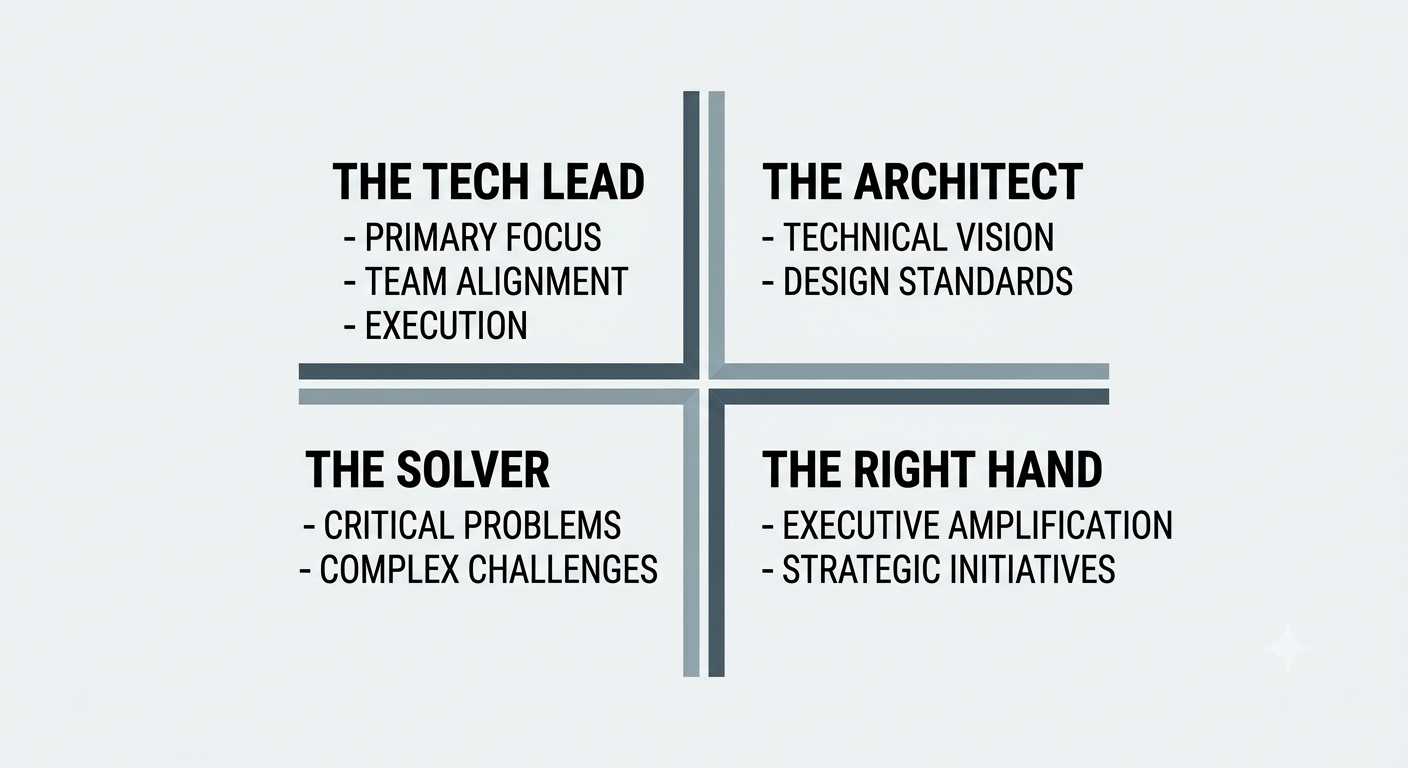
My note: the useful part of this framework isn't labelling yourself. It's realising that your company probably supports only one or two of these archetypes. If you're a natural Solver at a company that only promotes Tech Leads, no amount of great work will get you there. That's a company fit problem, not a skill problem.
Reading the book helped me name my own pattern. For most of my career I've operated as a Solver and an Architect, with shorter periods as a Tech Lead and even a Right Hand. In my current company I'm doing Architect and Solver work. Before reading this book, I had actually asked for an official Staff Engineer position, but the organisation is loosely structured and the request went nowhere; there simply wasn't a defined shape for that role. In hindsight, that was a lucky miss: the book made me realise I don't want to be a Staff+ engineer in the coming years anyway. I joined about four years ago as a Senior Software Engineer without thinking much about my next step, and I stayed because the people are good and I like the project. But this chapter made the trade-off clear: if the shape of the role you want doesn't exist where you are, you either build it or you move. With the experience I've collected over these years, I'm leaning toward the second option, and this time toward an Engineering Manager role.
What staff engineers actually do
Past the archetypes, Larson identifies the common threads of staff-plus work:
- Setting technical direction. Less "genius architect drawing diagrams" and more listening, writing, and nudging the org toward fewer, better technology choices.
- Sponsorship and mentorship. A big chunk of your impact is growing the engineers around you, whether or not anyone tracks it.
- Injecting engineering context into decisions. Being in the room where roadmaps and budgets get decided, and representing the engineering perspective well enough to keep getting invited back.
- Glue work. The unblocking, coordinating, and gap-filling that keeps projects moving and that appears in nobody's job description.
- Staying visible. Writing things down, sharing decisions, being findable. Not for ego, but because a staff engineer nobody knows about can't have staff-level impact.
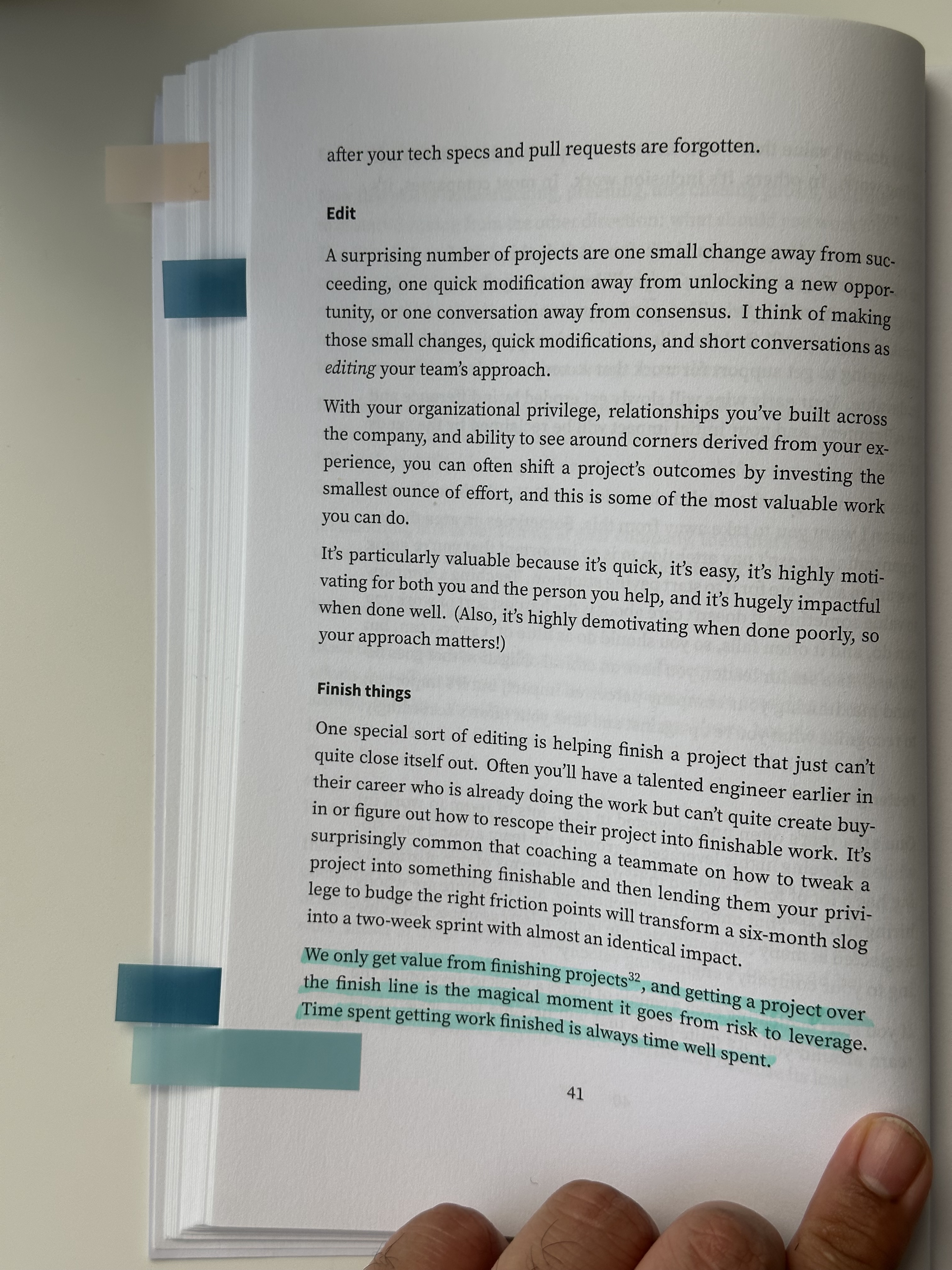
Getting the title: the promotion packet
This is the most practical chapter for most readers. Larson's advice is to write your own promotion packet before you need it:
- List the staff-level projects you've done, your specific role in them, and the impact in concrete terms.
- Compare that document with your company's staff criteria and find the gaps.
- Use the gaps as your roadmap for the next six to twelve months.
- Share it with your manager and make them a collaborator in closing the gaps.
The uncomfortable companion idea: you need a sponsor, usually your direct manager, who will actively fight for you in the promotion meeting. Doing great work that your manager doesn't know how to sell is one of the most common ways strong engineers get stuck at senior.
My note: this is the "run your career like a project" idea, and it clashes with how most engineers operate. We tend to assume good work speaks for itself. Larson's whole point is that it doesn't, and pretending otherwise just hands your career over to luck.
Sometimes the fastest way up is out
Larson doesn't pretend loyalty always pays. If your company has no staff engineers, or only promotes one archetype, or your manager won't sponsor you, then switching companies is often the pragmatic move. Plenty of the engineers interviewed in the book got their first staff title by joining a new company at that level instead of grinding through an internal promotion.
The counterweight: an internal promotion comes with an "exception budget," the accumulated trust and context you spend down when you join somewhere new. Neither path is free.
The title won't save you
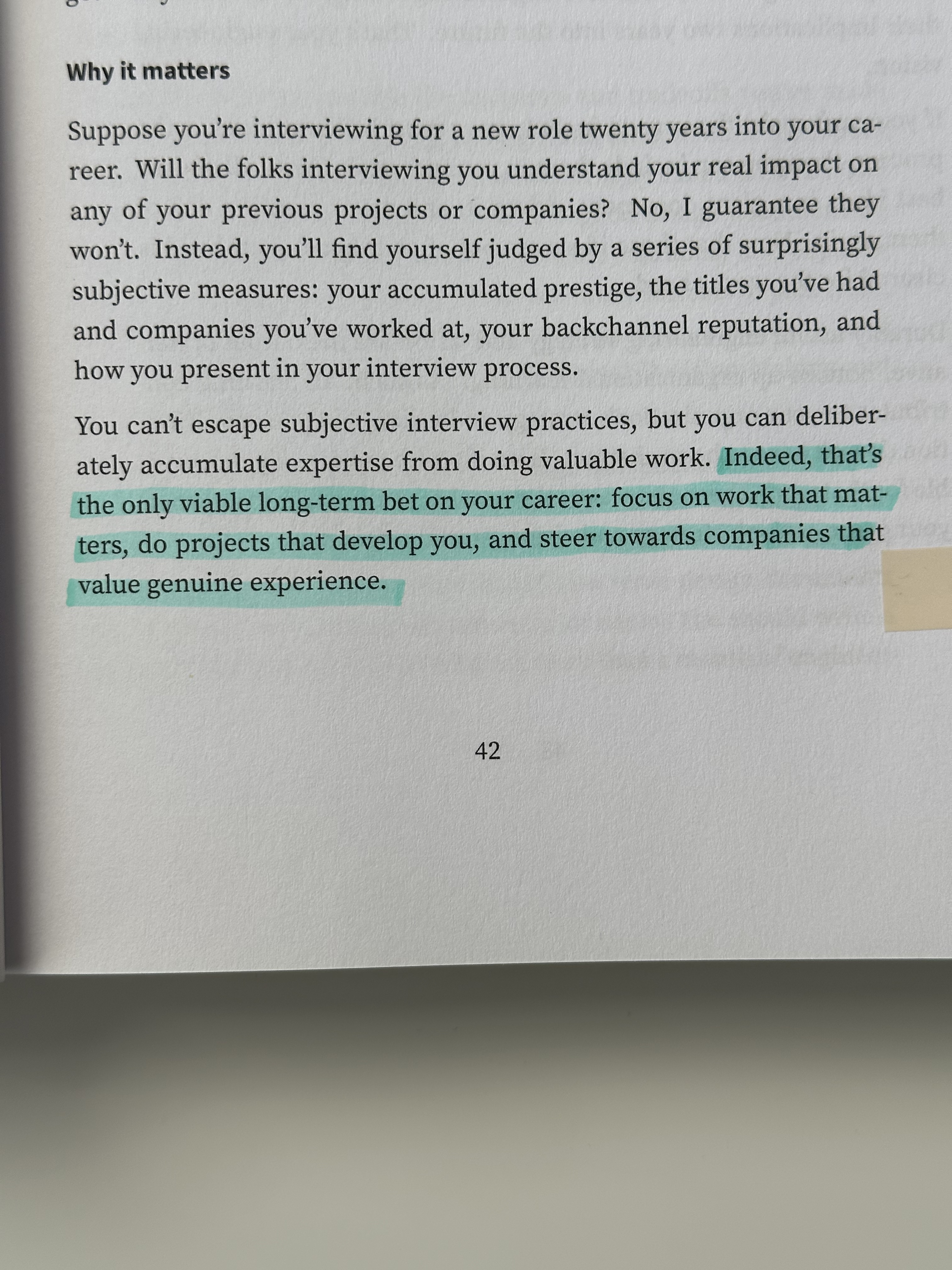
My favourite piece of realism in the book. Engineers imagine the staff title as the moment they finally get taken seriously, get into the right rooms, and stop having to prove themselves. In practice, Larson says, the title opens doors slightly faster and lets you skip a few pointless arguments, and that's roughly it. The problems you had at senior (influence, communication, saying no, managing your energy) come with you.
🪢 Conclusion
Staff Engineer is the best map I've seen of a career territory that, until recently, barely had any documentation at all. It won't hand you a promotion, but it will show you the terrain: what the job actually is, which shape of it your company supports, and what evidence you need to collect to get there.
If you're a senior engineer who wants to keep growing without giving up the technical work, read it. Most of it is also freely available at staffeng.com, which tells you something about the author's confidence in the material.
As for what changed after reading it: honestly, less my behavior and more my understanding of it. For years I've been trying to spend my energy on work that actually moves the project, giving colleagues room to grow and helping them shape their own ideas instead of replacing them with mine. This book confirmed those instincts were right, and gave me the vocabulary and framing to do it all more deliberately. The one genuinely new habit is documentation. When a manager left our company, most of what he knew left with him, and I'm now the person who understands the architecture best. I don't want the next engineer to inherit that silence, so I'm writing the documentation I wish I had received. It's exactly the kind of work Larson describes: invisible today, valuable for years, and it simply won't happen if I don't do it.
As for which track I chose, my next book notes will tell you: The Manager's Path.